Tektok

About Tektok

Tech musings of Kaishin, author of KaishinLab , 158 Kilopixels and Pause. You can subscribe to the RSS or follow Kaishin on Twitter.
It’s sad that BitTorrent is bashed just because some are using it to share copyrighted materials…
I have been enjoying every bit of Safari 5. Reader rocks, Top Sites looks as gorgeous as ever, and extensions rock my world. Here is a round-up of 3 great extensions to take your Youtube viewing experience to the next level. And I really mean it.
I suggested MainMenu to MacAppstorm and it made it to the final round-up!
Let’s say you’re working on an icon for an iOS app. The app is universal, so it should run on all iPhones (and iPod touches), and on the iPad. As a designer, you’re used to drawing icons at various sizes; this is a big part of what “icon design” is (as opposed to other types of illustration).
…
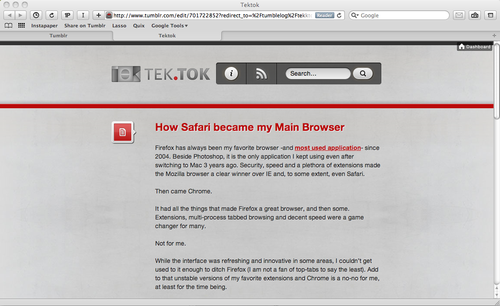
Firefox has always been my favorite browser -and most used application- since 2004. Beside Photoshop, it is the only application I kept using even after switching to Mac 3 years ago. Security, speed and a plethora of extensions made the Mozilla browser a clear winner over IE and, to some extent, even Safari.
Then came Chrome.
It had all the things that made Firefox a great browser, and then some. Extensions, multi-process tabbed browsing and decent speed were a game changer for many.
Not for me.
While the interface was refreshing and innovative in some areas, I couldn’t get used to it enough to ditch Firefox (I am not a fan of top-tabs to say the least). Add to that unstable versions of my favorite extensions and Chrome is a no-no for me, at least for the time being.
Then Apple updated Safari.
The last time I was excited about a Safari update was the release of 4.0, and that was a big letdown. As a devoted Firefox user (my DeviantArt gallery is a witness), my expectations were rather low for this release.
It’s all history now.
After having spent one evening installing the must-have extensions (ALL of which were available overnight without the stability issues of their Chrome counterparts!!), the brand new Apple browser was able to do everything my Firefox and Chrome did, only better and with style. And as if this wasn’t enough an incentive to switch, Apple threw in a gem that is powerful enough to make Safari a clear winner: Reader.
Instant kill.
Reader strips all the distractions -read obtrusive ads- and leaves you with a clean layout for an efficient and pleasing reading experience. It even supports multi-page articles, adding insult to injury to advertisers and publishers relying heavily on ad revenues, while making internet a better place to be.

In the lapse of 3 days, Firefox had already lost its top spot as my most used application. The furry fox icon had to leave my dock, for the first time in six years.

It seems like Spanish judges are the only ones around to truly understand P2P. In a recent legal case, they ruled in a favor of a link sharing forum, likening P2P to lending. I wholeheartedly agree.
Lending has always existed as a form of sharing with friends and relatives, and it is 100% legal as long as the lender is not making any profit from it. P2P is just an evolved form of lending: it has lifted physical restrictions (optical media, paper…) while broadening the circle of potential lenders / borrowers.
There is a common misconception that P2P and piracy are synonyms. This couldn’t be further from truth: not only are there legal P2P networks (google “legal torrents”), but P2P does rarely involve any form of profit or monetary transaction.
Making profit from pirated copies is indeed unforgivable, but hunting down every link sharing forum for copyright infringement is the worst investment content creators can make, especially when those resources spent on law firms can be used to explore new profitable business models.
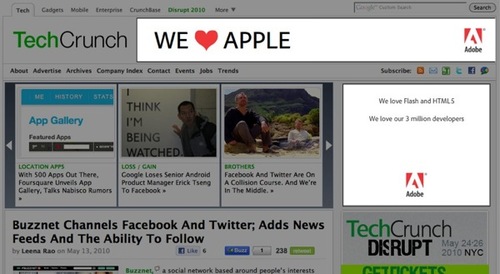
A lot happened since my last post about the Apple/Adobe clash. First, Apple has posted on their website a lengthy letter explaining why they are so obstinate to ward off flash from their ecosystem. Their main arguments included the closed nature of Flash, poor performance and the inefficiency caused by an extra layer between developers and Apple. Adobe CEO responded to Apple claims, saying that the open letter was nothing more than a ‘smokescreen’. And now, it seems that Adobe have taken it to the next level, running flash ads on popular tech website Techcrunch. Clicking these ads leads you to Adobe’s official website, where they argue that they love choice, not rich media market share.
UPDATE: It looks like it is a full-fledged ad campaign spotted in various places around the web.
Even though commenting tech gossip isn’t my favorite preoccupation, here is my take on this whole brouhaha:
Both Apple or Adobe are doing nothing but trying to protect their stakes and secure their revenues for the years to come. It’s a survival game, nothing to get emotional about. Should I remind all of you who are taking sides that in business, the word ‘taboo’ is taboo?
Bottom line? This PR ping pong isn’t getting any funnier.
I am off.
Few months ago, I briefly mentioned how Apple excels at making the first move and obliging it’s competitors to play by its rules. Well, that didn’t take them more than two months with the iPad and the tablet market.
Two weeks ago, both Microsoft and HP, two tech giants with previous experience with tablets have ‘abandoned’ their previously announced tablet projects. To follow suit, RIM, makers of the now-less-popular-BlackBerry, announced last week that they are halting the development of their android powered tablet and are shifting to a BlackbBerry OS product. And while this is not directly tablet related, Nintendo, pioneers of touch based controls, have publicly announced that Apple is their ‘enemy of the future’.
In spite early skepticism, Apple has clearly redefined what a tablet is and what is not, convincing most tech giants that this form factor should run a lightweight mobile OS rather than a full-fledged desktop one.
Thank you Apple, without you the tech world would have been doomed.
The tension between Apple and Adobe has culminated after Apple decided two weeks ago to start rejecting apps that are not made from the ground up for the iPhone. While Microsoft might also be concerned, it is Adobe that was most infuriated with this decision. In fact, Adobe had invested time and money developing their new “compile for iPhone” feature in Flash CS5, and had based a big chunk of their marketing campaign on this feature. Now here is the deal: Adobe developed a solution to maintain the position of flash in the market. Apple changed its policy to preserve the independence of its ecosystem from third party technologies. This is a typical conflict of interests. The same goes for developers. Those who master Objective-C and Cocoa Touch (iPhone standards) were delighted, as this means only one thing for them: less competitors. Those who were enjoying a quick buck with sub-par converted apps were outraged, as this will undoubtedly make an end to their parasitism. I am not working for Apple or Adobe, nor am I a developer. I am a user, and here is my take on this story: Screw Adobe! Here is why: The “Write once, deploy everywhere” mantra means higher revenues for developers, but it also means “Buy anywhere, get the same” for us users!
Page 1 of 2
